Saturday, December 31, 2022

Dimension Reduction in Machine Learning. Why PCA?

Background on Dimension Reduction

Dimensionality Reduction in Machine Learning is the process of reducing the number of dimensions in the data by excluding less useful features (Feature Selection) or transforming the data into lower dimensions (Feature Extraction). Putting it simply, Dimension Reduction refers to the process of reducing the number of attributes in a dataset while keeping as much of the variation in the original dataset as possible.

When we reduce the dimensionality of a dataset, we lose some percentage (usually 1%-15% depending on the number of components or features we keep) of the variability in the original data. Though it offers the following advantages.

  • It prevents overfitting. Overfitting is a phenomenon in which the model learns too well from the training dataset and fails to generalize well for unseen real-world data.
  • A lower number of dimensions in data means less training time and fewer computational resources and increases the overall performance of machine learning algorithms
  • Dimensionality reduction is extremely useful for data visualization. Data in 2 or 3 dimensions is easier to visualize.
  • Dimensionality reduction removes noise in the data


As mentioned above, Dimension Reduction methods can be classified into two categories.

1.      Feature Selection

a.      Variance Seeking

The variance method of dimension reduction is a technique that aims to reduce the number of dimensions in a dataset by selecting a subset of the most important features that capture the most variance in the data. The goal is to reduce the dimensionality of the data while retaining as much information as possible.


There are a number of ways to select the most important features using the variance method. One common approach is to calculate the variance of each feature and select the features with the highest variance. Another approach is to use a feature selection algorithm, such as mutual information or the ANOVA F-test, to identify the most important features.


The variance method of dimension reduction is often used in combination with other dimension reduction techniques, such as Principal Component Analysis (PCA) or Independent Component Analysis (ICA), to further reduce the dimensionality of the data.

b.      Backward Elimination

This method eliminates (removes) features from a dataset through a recursive feature elimination (RFE) process. The algorithm first attempts to train the model on the initial set of features in the dataset and calculates the performance of the model (usually, the accuracy score for a classification model and RMSE for a regression model). Then, the algorithm drops one feature (variable) at a time, trains the model on the remaining features, and calculates the performance scores. The algorithm repeats eliminating features until it detects a small (or no) change in the performance score of the model and stops there!

c.      Forward Selection

This method can be considered as the opposite process of backward elimination. Instead of eliminating features recursively, the algorithm attempts to train the model on a single feature in the dataset and calculates the performance of the model (usually, accuracy score for a classification model and RMSE for a regression model). Then, the algorithm adds (selects) one feature (variable) at a time, trains the model on those features, and calculates the performance scores. The algorithm repeats adding features until it detects a small (or no) change in the performance score of the model and stops there!

d.      Important Features from Decision Trees of Random Forest

Random forest is a tree-based model which is widely used for regression and classification tasks on non-linear data. It can also be used for feature selection with its built-in feature_importances_ attribute which calculates feature importance scores for each feature based on the 'gini' criterion (a measure of the quality of a split of internal nodes) while training the model.


2.      Feature Extraction


Feature extraction techniques aim to transform the data from a high-dimensional space into a lower-dimensional space while preserving as much information as possible. These techniques can be either linear or non-linear, and they often involve creating new features from the original features using a mathematical transformation. It is best to visualize the data before the activity to observe its shape (linear or non-linear). Though it is important to realize that we can only visualize data in 3 or 4 dimensions. For that, we can reduce the number of dimensions through variance and visualize important dimensions based on any of the above

Linear Algorithms

a.       Principal component analysis (PCA): This method projects the data onto a lower-dimensional space by identifying the directions of maximum variance in the data.
 
b.      Linear discriminant analysis (LDA): This method projects the data onto a lower-dimensional space while maximizing the separation between different classes in the data.
 
c.      Singular value decomposition (SVD): This method decomposes the data matrix into the product of three matrices, which can be used to identify the principal components of the data.

 d.      Independent component analysis (ICA): This method seeks to identify independent latent factors that explain the variance in the data.

Non-Linear Algorithms

e.      Autoencoders: These are neural network architectures that are trained to reconstruct the input data from a lower-dimensional representation, effectively learning a compressed representation of the data.
 
f.       Kernel PCA: This method extends PCA to non-linear data by using a kernel function to map the data into a higher-dimensional space before performing PCA.
 
g.      t-distributed stochastic neighbor embedding (t-SNE): This method projects the data onto a lower-dimensional space while preserving the local structure of the data.


These are just a few of the many methods available for dimension reduction in machine learning. The appropriate method to use will depend on the specific characteristics of the data and the goals of the analysis.


Why PCA?

With everything said and done, the simple choice of the people aiming for Feature Extraction is Principal Component Analysis (PCA). Why? Because it is simple and runs through without much hyperparameter tuning. One reason for its popularity is that it is relatively simple to implement and understand, as it involves finding the eigenvectors and eigenvalues of the covariance matrix of the data. Another reason is that it has been well-studied and has a solid theoretical foundation.

PCA is also computationally efficient and can handle large datasets, making it suitable for use in many practical applications. In addition, it has been shown to work well on a wide range of data types, including continuous, categorical, and binary data.

Another reason that PCA is popular is that it is easy to interpret the results, as the principal components are ranked by their explained variance. This allows users to easily see which features are most important in explaining the variance in the data.

Overall, the simplicity, efficiency, and versatility of PCA make it a popular choice for dimension-reduction tasks. However, it's important to keep in mind that other dimension-reduction techniques may be more suitable for certain tasks, depending on the characteristics of the data and the requirements of the application. For example, Linear Discriminant Analysis (LDA) is a very solid technique that performs better than PCA in many cases. Both PCA and LDA reduce the number of dimensions in a dataset while retaining as much of the information as possible, though, unlike PCA, the main goal of LDA is to maximize the separation between classes in the data while minimizing the variance within each class. The extra input parameter of the target variable adds weight to the LDA which shows in its improved performance, particularly in the classification-based datasets.

Below are some areas to consider when choosing dimension-reduction techniques.


1.    Ensemble dimension reduction: Using feature extraction on top of feature selection, which could further increase the performance of machine learning algorithms.

2.    The type of data: Different dimension reduction techniques are better suited to different types of data. For example, Principal Component Analysis (PCA) is a good choice for continuous data, while Linear Discriminant Analysis (LDA) is better suited for categorical data.

3.  The goal of the analysis: Different dimension reduction techniques have different goals. Some techniques, such as PCA, aim to maximize the variance in the data, while others, such as LDA, aim to maximize the separation between different classes. It's important to choose a technique that aligns with the goals of the analysis.

4.  The number of dimensions: Some dimension reduction techniques are better suited to high-dimensional data, while others are more effective for low-dimensional data. For example, t-SNE is a good choice for visualizing high-dimensional data, while PCA is more suitable for reducing the dimensionality of large datasets.

5.   The complexity of the data: Some dimension reduction techniques, such as PCA, are relatively simple to implement and understand, while others, such as Independent Component Analysis (ICA), are more complex and may require more expertise to use effectively. It's important to choose a technique that is appropriate for the level of complexity of the data.


Overall, it's important to carefully consider the characteristics of the data and the goals of the analysis when choosing a dimension reduction technique. It may be necessary to try multiple techniques and compare the results to determine the most suitable technique for the task at hand. 

Saturday, October 24, 2015

Why every other Super Power is offering Pakistan Fighter Jets and what’s in it for Pakistan?

Couple of years back Pakistan was thirstily looking for a possible acquisition of fighter jets and no country besides China was offering them any. Now! US, Russia & China have offered fighter jets to Pakistan, good times to be in the top command of Pakistan Armed Force.

How will the deal go down is a question for the future but things are starting to get interesting. I don’t have all the details but these acquisition are not possible by paying the amount in cash, it is certainly a deal on credit. But the real question is what has prompted these countries to offer one of their leading jets to Pakistan, a country which is at odds with a so called Super Power. 

Let’s first take a look on what China is offering. FC-20 or more popularly known as J10B. Pakistan engineers/pilots were hooked on the jet a long time, the time when J10 was on trial. Pakistanis were so interested that they requested several modification and upgrade to the jet, which later lead to the creation of J10B. Now when the plane is ready Pakistan is having trouble with financing the acquisition, even though the chances of credit terms (they still have to pay back the loan). Then there is also the question of maintaining the plane. A new kind of jet means huge maintenance cost as they have to develop a whole infrastructure for it. News is that one of the trial plane is flying with a Chinese Engine – regular planes have Russian engine which is cause of concern – just in case relationship deteriorates with Russia.

Second in the line of offering is Russian SU35 fighter jet. The fighter has develop it’s identity as one of the most agile modern fighter jets – ideal for dogfights, which Pakistan is famous for. Though there is a School of Thought which believes that the age of dogfights is over – but not Pakistanis. Thanks due to sanction for most of the previous decade Pakistan was denied acquisition of latest fighter jets which have the capability to fire missiles that are beyond visual range (i.e BVR missiles), Pakistan has acquired the art of getting closer to the enemy and then popping up for a dogfight. The SU35 is not just about dogfights, it is one of most potent fighters in the Industry and the most advance product in offering for Pakistan. The reason Russia has offered it to Pakistan can be associated to
  1. India inclination to the United States has prompted Russia to take sides
  2. They are just finding new customer for their product
  3. Pakistan inclusion in SCO. A SCO member should be elevated to a superior standard.

And then there is ever so popular F-16s, which Pakistanis are ever so hungry for, they even jump in dumpster on chance of finding some part of the jet. Pakistanis give preference to the jet mainly because of two reasons. First, they already have a well set infrastructure for the plane, they can maintained the jets even through the sanctions and second that their pilots a very much accustom to the plane, reducing the training time plus they know the plane capabilities to furthest extant. What every fighter they choose, Pakistan would defiantly buy some of these fighters. The reason United States has offered the plane can be associated to
  1. Counter the Russian offering, prompting Pakistan to side with the US.
  2. Depleting Pakistan Air Force budget so they can’t focus developing JF-17 – A strategy the west have used repeatedly all over the world
  3. They have to utilize the grant given to Pakistan inside US only – I hate, when they do that.

With the above offerings Pakistan is really in a fix. Firstly, they have to side with someone. They also want to keep China happy, as they are the only one which would be offering them 5th Generation fighters when they ready. Whatever the outcome be, Long Live Pakistan


The writer is not an expert in the field. Any observation above are personal and should not be taken under consideration for any decision. The information summarized above is gained through news and open forums. 

Sunday, March 29, 2015

Committee or a Team


Having experienced of working with a Multinational and a Government Organization, I am well placed to discuss the difference between a Committee and a Team. The mentality of a committee is to spread responsibility while making a decision, which makes the whole idea to that they are here to save themselves, the decision may carry a qualification of some members that they are not with the decision. While a team may be violent inside, but to the outside the decision that they take are unified, they own the decision whether they like it or not.

While in a committee you may work against the decision, as you want to make sure that your opposition to the decision gets glorified. In a team no matter how much you are against the decision, you would work you ass-off to make the decision a successful one, because if the decision turns bad, the whole team gets burned.

In a committee you are just there to make decisions, while in a team you are made responsible to act together in achieving the objective.
 
There could be hundreds of other point, the above are crux of it all. A committee is just there to divide the concentration of fire, so that a single participant doesn't get a third degree burns.

Monday, March 23, 2015

A successful but hateful Strategy to re-energize Large Pakistani Organizations


Let's be clear on one thing, great leaders don't have time to give a single organization their whole life. They tend to have varied objectives in life, a single organization whether it be PIA, Steel Mill, Banks or even the State Bank of Pakistan has only a small footprint in overall scheme of things. If you are a great leader, you tend to move from places to places making revolutionary changes where ever you go.

At least, this has been the story of Pakistani Organization. A Leader comes in, with great power given to them, tasked to change the whole organizational culture. And there have been more than a couple of successful instances, were the same strategy has worked.

The strategy is simple, it acknowledges that there is no time to improve the current organization so they create a parallel organization within the organization, it has more power, resources and flexibility and it cuts the ties with old organization. The newly hired people in the new organization are comparatively fresh so they can be molded to the modern needs. What we have now are two completely different sets of people, one (comparatively) old aged, slow, bureaucratic, somewhat loyal and the second sets of people are better educated, young, fast paced, without any red tape culture, would work there ass off to complete the project on time and would move to a different organization without a second thought. There is a hiring freeze in the old organization so they don't grow and are slowly washed out, 'golden handshakes' also comes in the picture if they want get rid of them early.

So far the strategy has worked at State Bank, HBL (and other banks), Lucky group, K Electric and some other organizations. The results are somewhat confused but a lot better than what it would have been if nothing was done. Though one thing is for sure, the organizational output increases drastically.

How can you identify whether this strategy has been implemented in an organization or not. You will see on occasion a really frustrated employee who always have bad words for management, who sees the management as someone who are hell-bent on destroying the organization and on other occasions an employee who are specific, young, with decision making ability and people who work late hours.

Whether the strategy is good or not, would have a different answers depending from which angle you see. But one thing is for sure, the performance and quality of output increases twofold.

Saturday, March 21, 2015

How to Improve Pakistani Cricket


Finally, we are out of the World Cup race, a race we weren’t prepared for, a race we have been preparing for the last four years. What went wrong and what were the findings are discussed widely by cricket commentators and lovers alike. Muhammad Yousuf even suggested to fire all the batting line and never ever bring them again in the Pakistani Team. 

We are bursting on those people who have little control over the issue. The players did their best, that’s all they were capable of. The selection committee in the same way, did their best. The cycle won’t improve unless there is a grave effort in revamping the management process of the Pakistan Cricket Board. Pakistani cricketers are ‘thinking’ of playing with a strategy that is two decades old. Times have change and they need to change the way they play their cricket. But then again, a strategy is when someone actually has a plan, according to Amir Sohail, a veteran cricketer Pakistani Cricketers never played with a Strategy. They just focus on some players to perform outstandingly, if that clicks they think their strategy worked. These are all important issues but the main issue is not of operations rather a strategic change is needed. 

Things won’t improve unless politics is tied-up with the cricket. When Zulfiqar Ali Bhutto Nationalized the industries in Pakistan, he was not expecting that the Ministries would be handed over the control of their operations. Like most of the civilized world there are proper systems to govern the nationalized industries. One of the system which is in practice is to have a Board comprising of a mixture of Public and Private representatives from different walks of life, be it Philanthropist, Industry Practitioners, Ministry representatives, Judges, Entrepreneurs and people even from the organization itself, they make all the major decision including who will lead the organization. This system is in practice by many successful government organizations of Pakistan, one of them is the leading educational institution of the country, IBA Karachi. 

People of IBA are not hired from outside the country, they represent ordinary Pakistanis. What is different is the Governance structure. This same kind of system should be made for other organization of Pakistan, PCB should be the first one to have such kind of transition. Hopefully, we won’t see Ijaz Bhatt and Najam Sethi type of people that are just aristocrat, who are hugely flawed in the way they lead their organization.

Thursday, March 19, 2015

Waiting Lines - Fazaia Housing Scheme


Was quite interested when I heard about the PAF Housing complex, as a person who missed out on the Bahria and DHA bonanza, this was the time to cash-in on the project. The whole enthusiasm went in vain, when I saw some 200 people lineup at HBL bank for the Rs.1,000 forms. I don’t have that much time and energy, to stand all day in line for just the form. I initially thought of dropping the idea altogether, but just the next day someone called me for the forms, why me?

Oh Shit! I have a close relative at HBL head office, I am ‘THE’ person to contact for forms. I called up my relative to request for some forms. In return he told me that if I get hold of some, get him a couple, What!. The story was that PAF Fazaia Housing Scheme picked up the unsold forms from HBL as there was some news of mismanagement and even rioting, also that forms were sold in black, fetching 10k-15k per form. PAF intends to sell the forms at their own booths. Next day someone informed me that the booths were torn-off at PAF museum and the PAF staff fled the scene (with the forms L) not before a baton charge to the people queuing for the forms. 

Does the people know anything about the queue management, it’s a whole science. But as before, in Pakistan people feel proud when they see hundreds of people queuing up for something that they have. A very simple approach would have been to upload the form on a website and ask them to deposit the Rs.1,000 fees along with any other amount, when they were depositing the forms. Infact, it would have been further simplified if the amount was also deposited electronically, there are 10s of methods available these days.

For me, this time again I would be let to the helms of brokers who would either sell the file or eventually the plots on a premium. There is one important finding from the project, Karachiites are hungry for good investment and they are not comfortable with financial investments i.e. stocks or bonds. Trust has been shifted to Property Developers.


Sunday, June 2, 2013

Corporate Attire

I may be stepping over some nice toes here but I felt like talking on the issue. Having experienced seven years of Corporate life in Karachi, I have always seen men dressing in an uptight suiting or at least a dress pant and proper tucked in shirt, shorts are not acceptable even on casual fridays. While women can dress as they like, skirts will also do, exposing some extra skin is very acceptable, even preferred by many. While I believe in personal space and freedom, this does not fall in the personal domain, it creates conflict in admirers minds, distracts him or her from the goals of the business and society blames them on what is followed.

This does not stop here, pretty news casters are equally to blame for inciting viewers, yes I notice them, I am a guy. Their job is to deliver news not modeling, we have models & actors for that. Many organizations prefer keeping such beauty in house, as it helps accomplishing stretched goals, especially in the sales function. On the other side many companies are just too scared on touching this sensitive topic, as it  could label them as extremist, fundamentalist or even terrorist, a word coined to undermine others. Many organizations have gone out of their way to chalk down instructions in their manuals that limits individuals freedom in dressing, implementing that policy however is difficult task, you cannot ask a beautiful person wearing a low cut blouse to go cover it up-just too rude!.

The advent of sexual harassment laws have made this issue of an urgent nature, they are pushing victims of sexual harassment to report incidents to a special committee, which may result in prosecution, whether the committee realizes that the victim was also at fault is a question we would like answers for. But the issue is not of harassment, as offenders will be active even if proper dress code is followed. The implementers of the law are asking organization to train their employees in Sexual Harassment laws & how to report incidents, this presents a good opportunity to inform the participants on their own responsibility, on controlling the incidents, to wear decently. While my experience is limited to Karachi, the matter is of globally nature (I am talking about accomplishing corporate goals here). You can find several articles on corporate dress codes in the US, where it seems that they have risen to make clear policy guidelines & recommendations on corporate attire.

Tuesday, January 22, 2013

Pakistan's most critical issue

Ask a common Pakistani about the most critical issue of Pakistan, an astonishing 90% would give a single word answer, Zardari. A problem that alas has no end in sight, Zardari will be replaced by his likes from the dirty pool of Pakistani Politics, most hope for Imran Khan, a new face with new hope.

The most critical issue of Pakistan is not Zardari or our politicians in general, they are just a part of a bigger problem, that is fresh water. Fresh Water which produces Pakistan's 40% electricity, provides for agriculture which in turns provides 90%+ food & fiber, most raw materials for our industries (in the shape of cotton etc) and most essentially, the water we need to drink. In very accurate phrase, Pakistan won't survive without water.

Is something happening to water?

A lot is happening and a few times the media has also highlighted the issue but things get jumbled in between the many happenings in the country, from Veena Malik to Tahir-ul-Qadri, to the escalation on the borders. The armed forces are too busy protecting the borders and the politicians & bureaucrats busy playing "Zardari Zardari". The whole issue is the violation of the Indus water treaty.


The water from the Indus basin is distributed into two streams, western & eastern. The Western stream comprises of three rivers Indus, Jhelum & Chenab on which Pakistan has exclusive rights, while India has more or less exclusive rights over Eastern stream. As India need for water grew they built dams & diverted rivers on the western stream of Indus basin (violation of Indus Water treaty), which brings India in control of the Indus Basin waters, Pakistan’s primary source of freshwater source.

On top of it the supply from Indus has reduced considerably in the last decade, coupled with the use of water by India thins the supply of water to Pakistan.

What is Pakistan doing about it?


Chairman Pakistan Indus Water Commission, Jamat Ali Shah, the person responsible for not highlighting the issue when the dam was being constructed succeeded in escaping to Canada last year, despite his name being in the 'Exit control List'. The Government is in general not that interested to tackle the issue, they are too busy protecting their behinds. The armed forces are too focused on not getting them involved in politics.

That leaves Social societies & Individuals. A handful of people are protesting and highlighting the issue but nothing actionable is being done. On the positive side, Pakistan Business Council is taking action on the issue, what they can & cannot do is a question we all want answers for. Anatol Lieven in his book Pakistan: A hard Country highlighted water, as being the only issue that is threatening the existence of Pakistan. Majid Nizami Editor in Chief of The Nation daily newspaper advised Pakistanis to get themselves ready for war with India on water issue.

A war with India can be considered an extreme scenario but the questions we all should ask is

Can we survive without Indus?

Monday, January 7, 2013

Waiting Lines

Waiting lines seem to be the destiny of the common man these days. Just got my car refueled after waiting half an hour (good day indeed) in the gas line. Reaching home in a good mood, queried my wife about the Montessori admission form that she was supposed to pick up between 9 & 12 in the morning (according to the website and the call I made). The actual process was quite different, she learned. For the admission form to be collected, you first need to get a token that is available between 8 to 9am and there would be only 50 tokens issued each day for 3 days. Needless to say, people start forming a line early in the morning, I plan to go at 7am tomorrow.

Bit frustrated on the life we are living, my calendar reminded of the doctor's appointment I needed to make at LNH. The hospital's operator informed that the Doctor's OPD hours are between 9am & 12pm, though he will come around 10-10:30am and will only see the first 50 patients, on first come first served basis.

What is happening to Pakistan, are institutions so stupid that they don't know how to manage waiting lines, or do they believe that they themselves are the king of all heaven & earth. There is no value of a common man's time, we are just so worthless & minute in the eyes of institutions that they don't see this as a problem.There are thousand of ways to reduce long queues, but nobody is thinking on these lines. Or all this drama is actually a show of strength, an advertisement, to show how eager people are to get associated with us.

"How else would people know the value of the institution unless there is a long queue for it"

As for the nation to stand against this cruelty, as per a friend "our national animal should be a Buffalo, It keeps producing milk without objecting to the atrocities inflicted on it"

Tuesday, December 18, 2012

Rising to the top - the short way

If you are looking for a short way to rise on the corporate ladder, you won't find it here, go and do some actual work. What I am more interested is in shortest possible way that would put anyone close to the top management, from there on, it is all about hard work and luck to play its role.

The point came in a discussion with some marketing friends. As we all know the marketing folks are closest to top management! who better to dig out the influential tool. Yes it is a tool and its called 'Pricing'

How does pricing brings you closer to the top management.?

Well, for one, it is the thing in direct control of the top management, all other Ps (Product, Placement, & Promotion) are the result of extensive R&D, there is little that can be changed. Secondly it comes last in the four 'Ps', and we all know that we remember the closing argument/scene the most, that's what pricing offer, the last scene in a long play. On top of that, pricing translates into profit, pricing strategy sets mood for the profit to rise (or fall, in-case you are fired, don't say I didn't warn you) 

Speaking honestly, pricing is not that simple, it is actually quite difficult. It has to take under consideration all the factors, from the raw idea of the product till the consumer sees the product in the shelves, the whole supply chain has to be thoroughly studied and mastered. It means that to be a great pricing strategist, you must master the whole chain that it had followed. 

Tuesday, August 7, 2012

Optimism & Leadership

Seriously, In an environment like Pakistan, it is insane to be optimistic, where things usually go beyond your worst expectations. But for some people, it seems pessimism isn't an option. For example, Asad Umar (x-CEO Engro), the guy seriously went into expansion mode, bringing ENGRO, a company limited in its scope into entering a very competitive FOODS sector, which is heavily dominated by Multinationals. Though times were much better back then, but taking an organization into new waters and competing with the sharks, requires some seriously insane mindset.

But what do these people really gain, from being optimistic in a pessimistic environment?

No serious competition!!

There are not many insane people/organization out there, only resistance they get is from existing players, which are already playing it safe as they believe in the failure of the initiative without proper industry support. These leaders really make things go.

Dr. Ishrat Husain's initiative to revamp IBA & bringing it in the top 100 universities of the world seems to be ridiculously insane. But even if the initiative fails, it will surely bring the university in top 250, where none of the Pakistani universities have ever been before.

The outclass leadership of people like Asad Umar and Dr. Ishrat Husain is what this country actually needs, who can turn the tide in a high velocity storm.


Tuesday, June 12, 2012

Dilemma of Family Businesses in Pakistan

Family Businesses in Pakistan are the real success story, where most of the Businesses are run by Entrepreneurs' children & then their children and so on. There are very few cases where the torch has been handed over to Professionals. It seems that Entrepreneurs have little trust in professionals to run their businesses or there is something entirely different.

What this translates into?

The business growth is limited by the number and interest of Seth's children. 
I came across a story by Asad Umar speaking about the dilemma. He was traveling with a well known successful entrepreneur in Pakistan, during the discussion the Entrepreneur talked about the vast array of facilities offered by Bangladesh for the textile sectors in Pakistan and that many Pakistani Businesses are moving there.

That is where things get interesting, when Asad queried on the reason why he hadn't moved his Business there. The answer was

None of my children want to live in Bangladesh
 
If this is whats limiting the growth of businesses in Pakistan then there is an urgent need for the Business Schools to come up with research of those organization who have successfully handed over their business to professionals. Also, work should be done to change the mindset of the Seth's in Pakistan.

Wednesday, May 23, 2012

Putting your Ideas/Vision on Paper: Mind Mapping


How many times are we plagued with the problem of communicating our ideas to someone, the more time it takes to communicate, the blurry the idea becomes. In the end, what is really left in our minds are half-baked communications we made and even that information does not last long. The most innovative ideas are so complicated that even reworking through the earlier process does not help, often we use common sense to solve the issue and as they say, common sense is the biggest hurdle in the way of innovation.

One way to sort out this issue is mind-mapping, the technique is not new, some examples even date back to the 3rd Century. The technique is very much in use in today's world, in fact its usefulness has increased manifold due to increased complexity of personal & business life in the current world scenario, where deep thought is a luxury not everybody can afford.


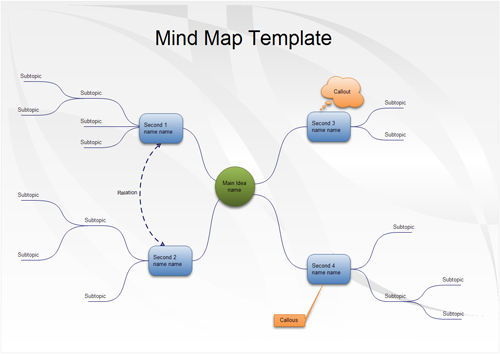
The technique starts with a word or an idea, which is then associated with concepts and thoughts, which in the end is associate with a task to accomplish, there is no restriction on the length of the chain. The idea is to reflect the thought process ending up with small tasks to be accomplished. Words cannot justify the benefits of this technique. A Practical application of the techniques reveals its benefits


Mind mapping can be used for an array of tasks, from personal, family, business, career or any aspect you want. For example, see the mind map above, where a candidate is working on the thought process for his job interview, working on the questions that can be asked or even those questions which will not be asked but inferred from the resume.
 
Mind-mapping can also be used for brainstorming, visual thinking, problem solving (even to Game theory). There are many softwares for mind mapping, one popular one is 'Freemind' which is freely available for download at download.com.

Wednesday, May 16, 2012

Serial Enterpreneurs

There is a lot of buzz about serial entrepreneurs in the written media, who are these people. Just like serial killers they are continuous in what they do, one after another. They have a lust for starting new businesses, establishing them but not necessarily managing them in the long run and they are really good at it.

For a country's growth, these people are a light shining brighter than anything else, these people should be identified and be given all the facilities (financing etc.) to start businesses. A program like TEDx should specially focus on these people.

More profiling and research should be done to identify them from their early stages, not to waste their crucial time. Babson College (Bostan, USA) and its sister concern IBA-CED (Karachi, Pakistan)
are among the many universities involved in entrepreneurial research, their focus is building not business managers rather entrepreneurs. These establishments should be supported, nurtured and  facilitated with everything they need and in time they can be expected to yield extraordinary results.


Monday, May 14, 2012

Employee Appraisal System


Organization spend millions for establishing a balanced employee appraisal system, which is targeted to concentrating the company resources to productive use (by asking employees to take up projects & projects have cost). Employees are themselves given the responsibility to quote their objectives, which may or may not be guided by their own motives. 

Assume 50 people having listed their own objectives, those objectives will be moving in their own directions, some for example may work on centralization others might concentrate their efforts on decentralization. 

Where would the organization end up? No where, because they don't have a direction. In the end all effort & cost put into the project goes down the drain. 

One solution for the problem is Balanced scorecard system, it first establishes core objectives for the organization, which in the end gives a list of objectives which can be assigned to teams or employees. These efforts when concentrated in a uni-directional manner, will yield positive results. 


Balanced scorecard is not the only solution for the problem, many more exist. The beauty of Balanced scorecard is in its larger system which takes into account many organizational issues like tracking progress, establishing critical efforts, resource generation etc. One benefit this tool has over others is that, a lot of effort has already been put into documenting the process and system, which makes it easier to understand.